
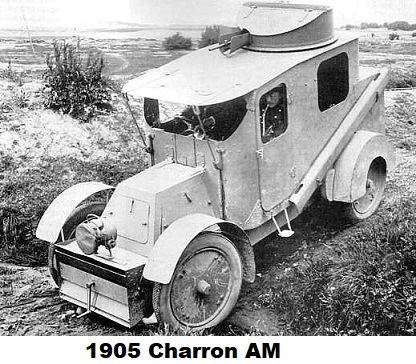
1905 Charron AM
Type:……………….Armoured Car
Place of origin:……..France
Service history
In service:………….Model 1905 – car chassis, enclosed armoured superstructure, fully rotating turret, 16 built (1905-06)
Production history
Designer:…………..M.A. Nakasjidze
Designed:…………..1904
Manufacturer:………Charron-Girardot-Voigt
Specifications
Weight:…………….3 metric tons
Length:……………..4.8 m
Width:………………1.7 m
Height:……………..2.4 m
Crew:……………….4 (commander, driver, mg crew)
Armour:…………….4 – 8 mm
1st armament:……..Hotchkiss M1902 machine gun
2nd armament:…….Hotchkiss M1902 machine gun
Engine:…………….CVG watercooled I4, 35hp
Suspension:………..4×2 wheel, leaf spring
Range:……………..100 km
Speed:……………..45 km/h
The world’s first fully armoured car was the French Charron, designed by a Russian officer, M.A. Nakasjidze, based on his experiences from the then ongoing Russo-Japanese war, and it was rolled out in 1905. It was basically an ordinary automobile, including large windows with shutters, equipped with a steel plate body and a roof mounted turret. Twelve were built and shipped by rail to Russia in 1908, two of these being seized in transit and tested thoroughly by the German army during maneuvers that year, and four Charron vehicles were used by the French army at the outbreak of WWI,
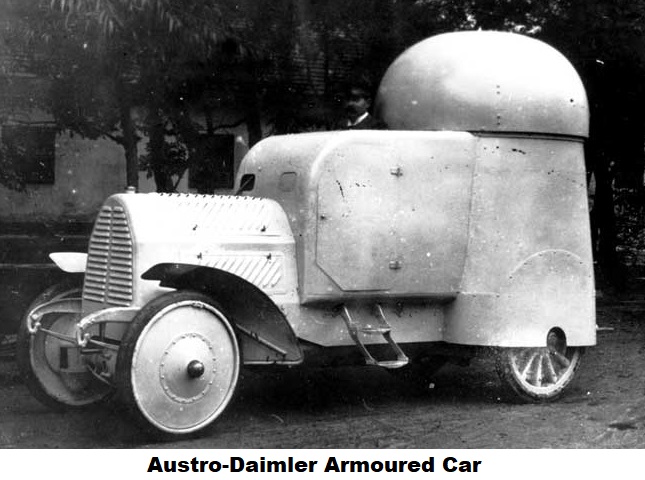
Austro-Daimler Armoured Car
Type:……………….Armoured Car
Place of origin:……..Austrian Empire
Service history
In service:………….Model 1904 – car chassis, enclosed superstructure, single fully rotating turret with one MG, 1 built (1904)
………………………..Model 1905 – fully rotating half turret with 2x MG, 1 modified (1905)
Production history
Designer:…………..David Daimler
Designed:…………..1904
Manufacturer:………Austro-Daimler
Specifications
Weight:…………….2.9 metric tons
Length:……………..4.1 m
Width:………………2.1 m
Height:……………..2.7 m
Crew:……………….4 (commander, mg crew driver)
Armour:…………….3 – 4 mm
1st armament:……..2x 7.62 Maxim Machine Guns
2nd armament:…….none
Engine:…………….Daimler 4.4L watercooled I4, 35hp
Suspension:………..4×4 wheel, leaf spring
Range:……………..250 km
Speed:……………..45 km/h
Paul Daimler, son of the famous Gottlieb Daimler, was the chief engineer of the Osterreichisches Daimler Motoren AG until 1905, and it was under his supervision that the Austro-Daimler Armoured Car was built. This vehicle had a specification including four wheel drive, an enclosed hull of a curved shape, and a dome-shaped rotating turret. Seats for the driver and co-driver could be raised or lowered by about 12 inches, so that when not in action the driver/co-driver could see over the top of the armour. The turret was originally built with just one port, for the Maxim water cooled machine gun. In 1905 this was changed, and two slightly smaller ports were added, for two Maxims side by side. The Austro-Daimler armoured car was demonstrated to the German Imperial Army at the Kaiser Manoeuvres in 1905, to the Austro-Hungarian Army at their manoevres in 1906 but it was not adopted by either country. The Austro-Daimler armoured car has the dubious honour of being the first turreted armoured car, and undoubtedly influenced later designs.
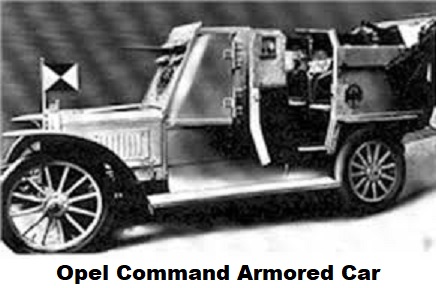
Opel Command Armored Car
Type:……………….Armoured Car
Place of origin:……..German Empire
Service history
In service:………….Model 1906 – car chassis, open superstructure 1 built (1906)
Production history
Designer:…………..Emil Schmidt
Designed:…………..1906
Manufacturer:………Opel
Specifications
Weight:…………….3 metric tons
Length:……………..4 m
Width:………………1.9 m
Height:……………..1.8 m
Crew:……………….2 + 4 (commander, driver, passengers or optional mg crew)
Armour:…………….5 mm
1st armament:……..8 mm Mauser MG01 machine gun
2nd armament:…….8 mm Mauser MG01 machine gun
Engine:…………….Darracq 6.8L watercooled I4, 40hp
Suspension:………..4×2 wheel, leaf spring
Range:……………..?km
Speed:……………..50 km/h
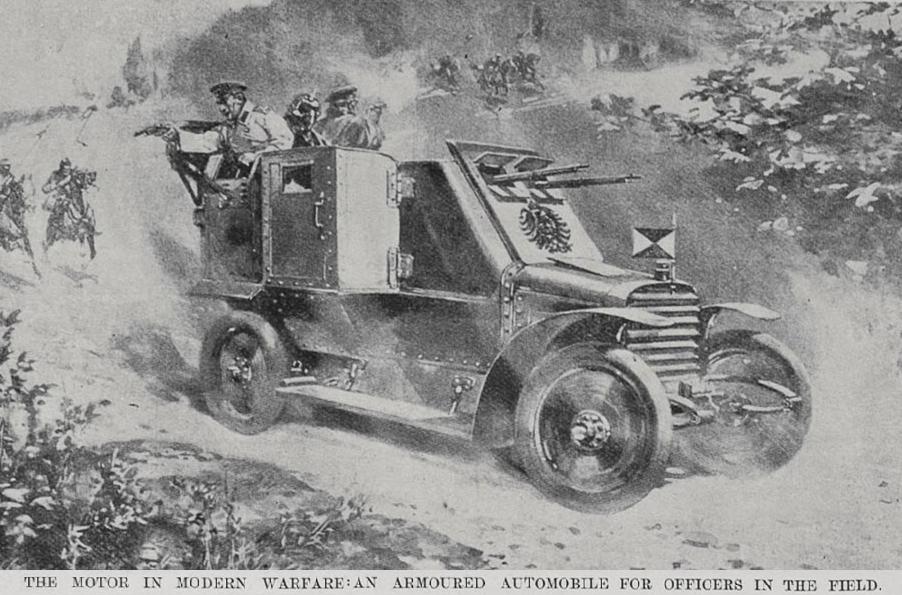
The Opel company introduced one of the first versions of the armored car to the order of the German War Office in 1906 and unveiled its first project in the automotive exhibition in the same year. It was the headquarters polubronirovanny armored car. The outlines of the vehicle were similar to an ordinary heavy motorcar except that the whole of the body was heavily armoured with steel plates and the surface was constructed with as few projections as possible. The interior was fitted with six seats, for crew and 4 passengers or a machine gun crew. One mg could be mounted in the body, and swivelled in any direction, while a second one was placed in the co-drivers position of the covered driving compartment. Two telescopes were placed between the fixed and revolving seats—one on each side of the car—on immovable stands and was outfitted wit two desks and appropriate storage for the accommodation of maps. Though this would have served as an excellent reconnissance or command vehicle, the German command did not show much interest in the car.
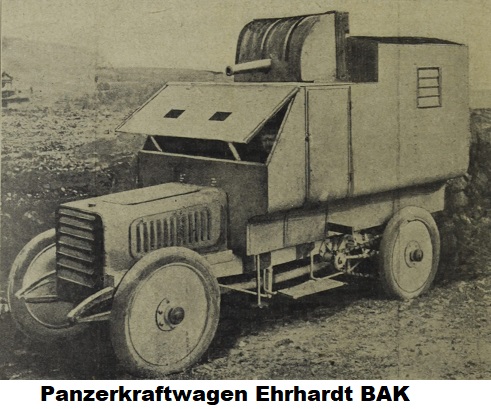
Panzerkraftwagen Ehrhardt BAK (Ballon Abwehr Kanone)
Type:……………….Armoured Car
Place of origin:……..German Empire
Service history
In service:………….Model 1906 – truck chassis, enclosed superstructure, single non-rotating turret, 4×2 wheel, 50mm/L30 gun, 1 built (1906)
………………………..Model 1909 – fully rotating turret, 75mm gun, 1 modified (1909)
Production history
Designer:…………..Ehrhardt
Designed:…………..1906
Manufacturer:………Ehrhardt
Specifications
Weight:…………….3.2 metric tons
Length:……………..5.5 m
Width:………………2 m
Height:……………..3.1 m
Crew:……………….5 (commander, gunner, loader, driver)
Armour:…………….5 mm
1st armament:……..Ehrhardt 75mm/L31 gun
2nd armament:…….none
Engine:…………….Ehrhardt watercooled I4, 60hp
Suspension:………..4×4 wheel, leaf spring
Range:……………..160 km
Speed:……………..45 km/h
The development of German armoured Cars began in 1906 with the Ehrhardt BAK (Ballon Abwehr Kanone), actually an armoured anti-aircraft platform. But there was little interest despite Ehrhardt having a single armoured car tested in the United States,
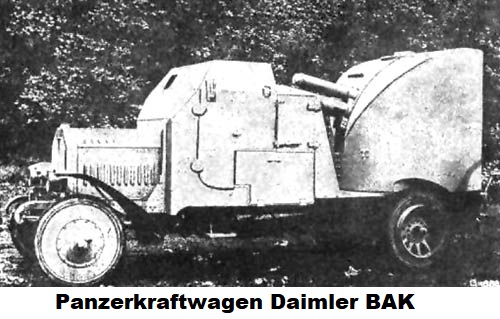
Panzerkraftwagen Daimler BAK
Type:……………….Armoured Car
Place of origin:……..German Empire
Service history
In service:………….Model 1908 – truck chassis, enclosed superstructure, fully rotating turret, 57mm/L35 gun, 2 built (1908)
………………………..Model 1909 – upgunned, 1 modified (1909)
Production history
Designer:…………..Daimler
Designed:…………..1908
Manufacturer:………Daimler
Specifications
Weight:…………….6 metric tons
Length:……………..4.5 m
Width:………………2 m
Height:……………..2.2 m
Crew:……………….4 (commander, gunner, loader, driver)
Armour:…………….3.5 mm
1st armament:……..Krupp 71mm/L28 gun
2nd armament:…….none
Engine:…………….Ehrhardt watercooled I4, 60hp
Suspension:………..4×4 wheel, leaf spring
Range:……………..?km
Speed:……………..45 km/h
After just two years after the release of 50-mm self-propelled protivoaerostatnoy Ehrhardt German company Daimler has created a much more sophisticated self-propelled. Tests of this anti-aircraft armored car, often called Panzerkraftwagen Daimler 5.7cm BAK, where successfully completed in 1909, but the leadership of the German army again showed little interest.
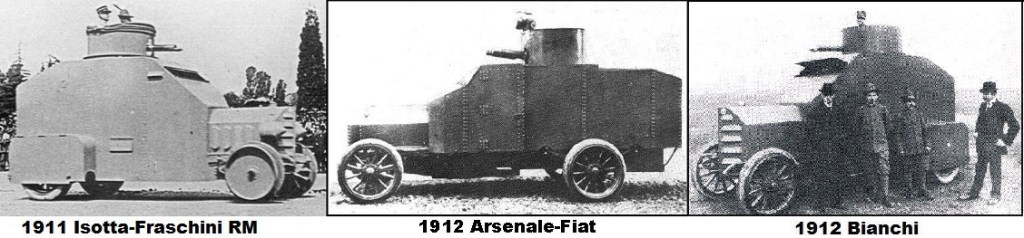
1911 Isotta-Fraschini RM
Type:……………….Armoured Car
Place of origin:……..Italy
Service history
In service:………….Model 1911 – car chassis, enclosed superstructure, single fully rotating turret, 2 built (1911)
………………………..Model 1912 – Arsenale copy on Fiat chassis, 1 built. Bianchi copy, 6 mm armour, 30hp engine, 2 built (1912-13)
Production history
Designer:…………..Isotta-Fraschini
Designed:…………..1911
Manufacturer:………Isotta-Fraschini
Specifications
Weight:…………….2.7 metric tons
Length:……………..?m
Width:………………?m
Height:……………..?m
Crew:……………….4 (commander,driver, mg gun crew)
Armour:…………….4 mm
1st armament:……..6.5mm Vickers machine-guns
2nd armament:…….6.5mm Vickers machine-guns
Engine:…………….Isotta-Fraschini watercooled I4, 40hp
Suspension:………..4×2 wheel (double rear wheels), leaf spring
Range:……………..?km
Speed:……………..60 km/h
By 1912, the SA Fabbrica Automobili Isotta Fraschini of Milan had expanded its activities into the field of armoured car construction. The company produced two armoured cars, differing in details only, as a private venture and, at the request of the Italian Army, the Artillery Arsenal of Turin built a third example in 1912 based on a Fiat truck chassis. Bianchi also built copies in 1912 and 1913, distinguishable by its rounded bonnet shape, as well as an open topped version in 1914-16. These cars all emphasised heavy armour protection, which unduly penalised the machines as far as speed and mobility were concerned. Italy was the first country to use a machine gun armed armoured car in true war operations, in late 1912, when such vehicles were sent to North Africa as part of the Italo-Turkish conflict.
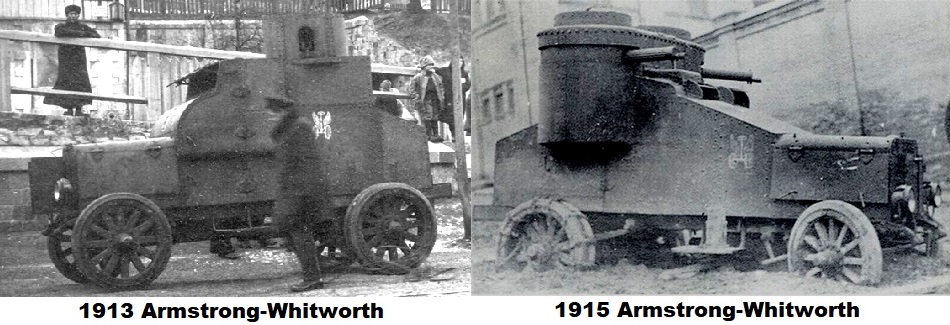
1913 Armstrong-Whitworth AC
Type:……………….Armoured Car
Place of origin:……..British Empire/Russian Empire
Service history
In service:………….Model 1913 – truck chassis, enclosed armoured superstructure, single fully rotating turret, 37 built (1913-15)
………………………..Model 1915 – Russian copy, twin turrets, 2 built (1915)
Production history
Designer:…………..Armstrong-Withworth
Designed:…………..1913
Manufacturer:………Armstrong-Withworth
Specifications
Weight:…………….3.4 metric tons
Length:……………..3.9 m
Width:………………1.7 m
Height:……………..2.4 m
Crew:……………….4 (commander,driver, mg gun crew)
Armour:…………….3 – 5 mm
1st armament:………303 Vickers machine-guns
2nd armament:…….none
Engine:…………….Armstrong-Whitworth watercooled I4, 20hp
Suspension:………..4×2 wheel (double rear wheels), leaf spring
Range:……………..200 km
Speed:……………..45 km/h
Very little is known about this Armstrong-Withworth armoured car. A prototype was ordered and tested by Russia as early as 1913 and a batch of 36 vehicle was received by them by the fall of 1915 but it was never accepted in service by the British Army. The configuration was straightforward, with the driver’s compartment forward, with one access door on each side, and the fighting compartment just behind, with a single, fully revolving drum turret operated by a standing man. The high center of gravity, the high ground pressure and the performances of the car were abysmal on soft ground.
BIBLIOGRAPHY
Early Armoured Cars, E Bartholomew, Shire Publications Ltd, 1988
http://www.soldatinidicarta.altervista.org/WW1%20-%20Early%20Armored%20Cars.pdf
WW1 Armoured Cars, War is Over
http://www.wio.ru/tank/ww1ba.htm
Armoured Car Articles, various authors, Landships II
http://www.landships.info/landships/car_articles.html#
Tanks: Over 250 of the World’s Tanks and Armoured Fighting Vehicles By Chris Chant, Richard Jones, Summertime Publishing Ltd, 2004
http://books.google.ca/books?id=8CwgxzMqrv0C&pg=PA48&lpg=PA48&dq=Minerva+armoured+car+in+russia&source=bl&ots=56iUkXaXns&sig=RLGuTvCVEzzGXMN0tn19fsS5NR0&hl=en&sa=X&ei=ZbZ-UvOKI4f8iwK814G4Cw&ved=0CHIQ6AEwCw#v=onepage&q=Minerva%20armoured%20car%20in%20russia&f=false
WWI – Belgium Armoured Car Division in Russia by Michael Barden, 16 April 2011
http://www.philatelicdatabase.com/postal-history/wwi-belgium-armoured-car-division-in-russia/
THEY SAID IT WAS PEERLESS by David Fletcher, Classic Military Vehicle 119, April 2011
http://www.cmvmag.co.uk/features/67-they-said-it-was-peerless
American Military Vehicles of World War I by Albert Mroz, McFarland and Co, 2009
http://www.offroadvehicle.ru/AZBUCAR/FWD/%5BAlbert_Mroz%5D_American_Military_Vehicles_of_World_%28Bookos.org%29.pdf
 In Janissarius Scripturam