
BELGIUM
Minerva AM
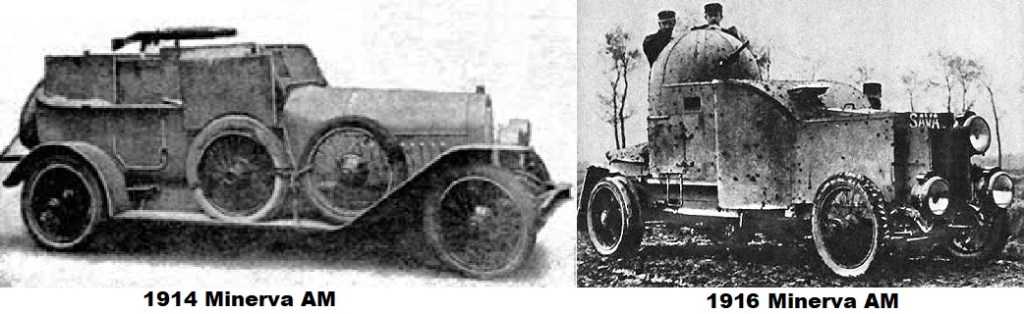
Type: Armoured Car
Place of origin: Belgium
Service history
In service: Minerva AC (MG) mle 1914, Car chassis, 4mm armoured bodywork, open superstructure, 30 built (1914)
Minerva AC (MG) mle 1916, updated as per SAVA AC, single fully rotating turret, additional 5 built (1916)
Production history
Designer: Lt. Charles Henkart
Designed: 1914
Manufacturer: Cockerill & Co
Specifications
Weight: 4. metric tons
Length: 4.9 m
Width: 1.8 m
Height: 2.3 m
Crew: 4 (commander, mg gunner, mg loader, driver) + 2 riflemen
Armour: 4 – 7mm
Main armament: 8mm Hotchkiss Mdl 1909 machine-gun
Secondary armament: none
Engine: Minerva 8L liquid cooled petrol I4, 40 hp
Suspension: 4×2 wheel (double rear wheels), leaf spring
Range: 150 km
Speed: 40 km/h,
off road: ?
Despite previous efforts of both the German and French armies to build armoured cars, it was Belgium, which produced the first effective ones. Soon they established a reputation, such that the enemy started tracking them down. The Belgian GHQ created the Corps d’Auto-Canons Mitrailleuses, attached to the 1st Cavalry Division, from early September 1914. They were used for reconnaissance, intelligence and infantry support in attacks and operations behind enemy lines. until mid-October, at which time the Belgian army was ensconced behind the river Yser. Production ceased in October 1914, when the factory was overrun by the advancing German Army, however 1915 saw existing cars upgraded as per two examples built by SAVA prior to german occupation. Armour layout was revised with an enclosed superstructure and dome turret fitted at rear. As the static war continued, their role effectively ended in Belgium so King Albert decided to put his armoured car corps at his cousin’s, Czar Nicholas II, disposal in Galicia (Ukraine). The decision to create an independent unit of some 350 volunteers billeted in Paris, the Corps Expeditionnaire des Belges (CEB), was made in Nov 1914. While in France, 4 Mors and 2 Peugeot were built mounting 37 mm naval cannon, 4 Mors armed with 2 x Hotchkiss machine guns and 3 unarmed Mors armoured command cars for the new unit. The CEB also purchased some English Lanchester armoured cars to replace lost Minervas. The Germans captured four model 1914, and modified them for their own use.
BRITAIN
Rolls-Royce AC
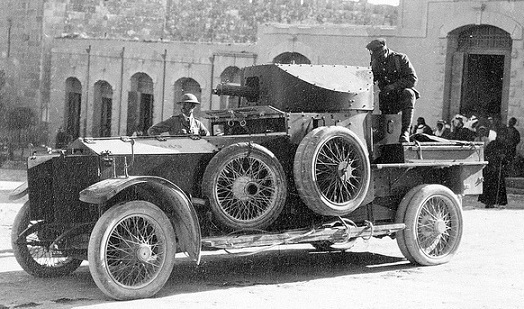
Type: Armoured Car
Place of origin: United Kingdom
Service history
In service: Mdl 1914 – Car chassis, armoured bodywork, single fully rotating turret. 120 bult (1915-1917)
Production history
Designer: Rolls-Royce
Designed: 1914
Manufacturer: Rolls-Royce
Specifications
Weight: 4.7 metric tons
Length: 4.93 m
Width: 1.93 m
Height: 2.52 m
Crew: 3 (commander, gunner, driver)
Armour: 12 mm
Main armament: .303 Vickers machine gun
Secondary armament: none
Engine: Rolls-Royce 7.4L liquid cooled petrol I6, 80 hp
Suspension: 4×2 wheel (double rear wheels), leaf spring
Range: 240 km
Speed: 80 km/h,
off road: ?
The Royal Naval Air Service (RNAS) raised the first British armoured car squadron during the First World War and for a time were the UK’s only mechanised land forces. It was the RNAS which provided much of the mobile cover using armoured cars, during the withdrawal from Antwerp to the Yser where the primitive predecessors of the Rolls-Royce cars had served, in 1914. In September 1914 all available Rolls Royce Silver Ghost chassis were requisitioned to form the basis for the new armoured car. The Rolls-Royce was one of the “Admiral Pattern” armoured cars along with the Lanchester, Talbot and Delaunay-Belleville. The first three vehicles were delivered on 3 December 1914, although by then the mobile period on the Western Front, had already come to an end. The Royal Naval Armoured Car Division (RNACD) eventually expanding to 20 squadrons and were redeployed to other theatres including the Middle East, Romania and Russia. In the summer of 1915 the RNACD was disbanded and the army took over control of armoured cars, with the units being formed into Light Armoured Motor Batteries under the command of the Motor Branch of the Machine Gun Corps. No. 20 Squadron RNAS was retained under Naval control to further develop armoured vehicles for land battle, becoming the nucleus of the team that developed the first tanks.
Lanchester AC
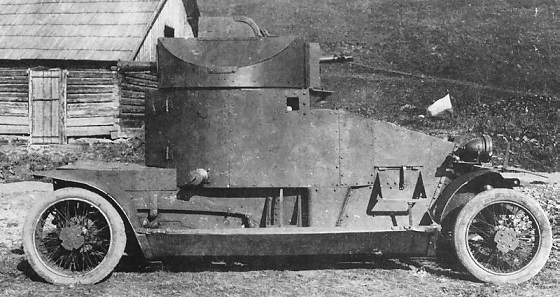
Type: Armoured Car
Place of origin: United Kingdom
Service history
In service: Mdl 1915 – Car chassis, armoured bodywork, single fully rotating turret. 72 built (1915-1917)
Production history
Designer: Lanchester
Designed: 1914
Manufacturer: Lanchester
Specifications
Weight: 4.7 metric tons
Length: 4.88 m
Width: 1.93 m
Height: 2.29 m
Crew: 3 – 4 (commander, 2x gunner, driver)
Armour: 8 mm
Main armament: .303 Vickers machine gun
or Mdl 1916 37 mm Hotchkiss gun
Secondary armament: .303 Lewis machine gun
Engine: Lanchester 4.8 liter liquid cooled petrol I6, 60 hp
Suspension: 4×2 wheel (double rear wheels), leaf spring
Range: 290 km
Speed: 80 km/h,
off road: ?
The Lanchester was the second most numerous armoured car in service after the Rolls-Royce and, in 1915 equiped three RNAS armoured car squadrons of 12 vehicles each. In addition, Belgium received 10–15 car and the Russian Army received 22 vehicles (19 were rearmed with 37-mm Hotchkiss guns). During most of its service life, the Lanchester was considered a fast and reliable vehicle but when the British Army took over control of all armoured cars they standardized on the Rolls-Royce pattern and the Lanchesters were then sent to Russia in January 1916 with the RNAS expedition force.
Austin AC
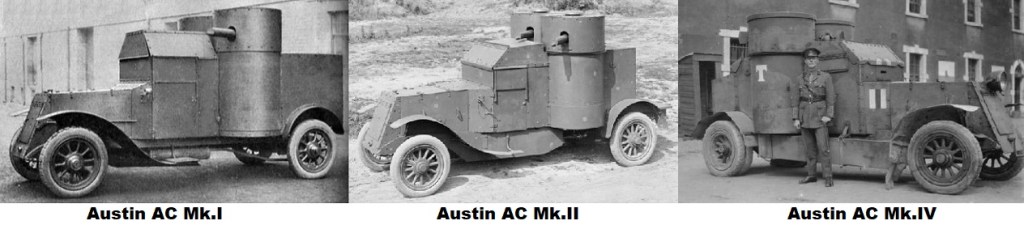
Type: Armoured Car
Place of origin: United Kingdom
Service history
In service: Series 1 – Car chassis, 4mm armoured bodywork, 2x fully rotating turret, 30hp engine, 48 built (1914)
Series 2 – 1.5 ton truck chassis, 6mm armour, 50hp engine, 60 built (1915)
Series 3 – MG shields, 2nd rear driver, bulletproof glass in the front vision slots, side slots, 60 built (1916)
Series 4 – strengthened chassis, double rear wheels, 36 of 70 built (1917)
Production history
Designer: Austin
Designed: 1914
Manufacturer: Austin
Specifications
Weight: 5.3 metric tons
Length: 4.9 m
Width: 2.03 m
Height: 2.84 m
Crew: 4 – 5 (commander, 2x gunner, 2x driver)
Armour: 6 mm
Main armament: 2x 7.7mm Hotchkiss Mle.14 machine guns
Secondary armament: none
Engine: Austin liquid cooled petrol I4, 50 hp
Suspension: 4×2 wheel (double rear wheels), leaf spring
Range: 201 km
Speed: 56 km/h,
off road: ?
In August 1914, just after the beginning of the First World War, the army of the Russian Empire started to form armoured car units. To meet these requirements, the Austin Motor Company designed a new armoured car, known as Austin 1st series,Two Maxim machine guns were mounted in separate turrets placed on both sides of the hull behind the driver’s cab. Additional armour added in Russia made the Austins much heavier, resulting in limited mobility and occasionally in chassis damage. On 6 March 1915 the Russians ordered vehicles of an improved design, known as Austin 2nd series built on the shorter chassis of a 1.5 ton truck with thicker armour and a more powerful engine. After arrival to Russia all vehicles were fitted with a redesigned rear hull section, which housed a second driving post to improve their manoeuvrability, and side shields for the machine guns. On 25 August 1916, Austin 3rd series were ordered with all the characteristics to the 2nd series, but with bulletproof glass in the front vision slots and side vison slots instead of big side windows.
The Austin 4th series, with strengthened chassis and double rear wheels was ordered in 1917 but due to events in Russia none were delivered and were instead issued to the British Tank Corps, referred to as Austin model 1918. The 17th (Armoured Car) Battalion, Tank Corps, received 16 of them, armed with 8mm Hotchkiss Mle.14 machine guns around May 1918 and at least 20 cars were sent to the Caspian Sea in February 1918, with a British unit known as Dunsterforce, to protect oil wells at Baku against the Turks. Their first battle was on 11 June 1918 in support of the French troops and on 8 August, at the Battle of Amiens, tanks were used to tow them over the trenches after which they were loosed to operated miles behind the German lines.
1916 Armstrong-Whitworth Fiat AC
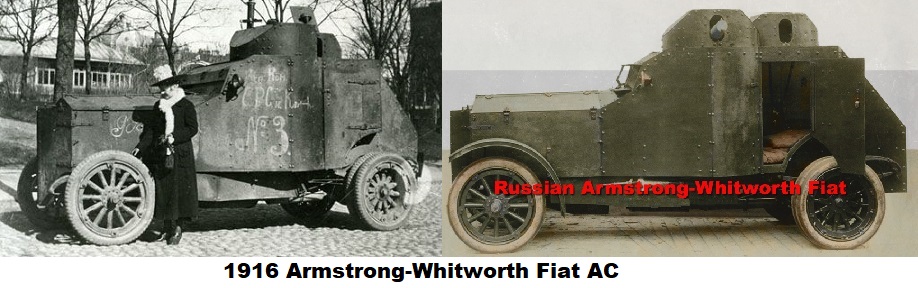
Type: Armoured Car
Place of origin: United Kingdom
Service history
In service: Car chassis, armoured bodywork, 2x fully rotating turret. 40 built (1916)
Production history
Designer: Armstrong-Whitworth
Designed: 1916
Manufacturer: Armstrong-Whitworth
Specifications
Weight: 5.3 metric tons
Length: 4.9 m
Width: 1.9 m
Height: 2.5 m
Crew: 4 – 5 (commander, 2x gunner, 2x driver)
Armour: 7 mm
Main armament: 2x .303 Vickers machine gun
Secondary armament: None
Engine: Fiat liquid cooled petrol I4, 60 hp
or Garrot liquid cooled petrol I4, 38 hp
Suspension: 4×2 wheel (double rear wheels), leaf spring
Range: 140 km
Speed: 60 km/h,
off road: ?
The Armstrong-Whitworth armored cars, based on both the Garrot and Fiat chassis, were one of many armoured cars built in Britain for Russian service. The cars underwent much needed modifications to strengthen their suspension and improve armour protection, upon arrival in Russia, and began arriving at the front during the end of 1916 and beginning of 1917. These bear a striking similarity to the Austin Armoured Car and could easily be mistaken for them.
Seabrook AC
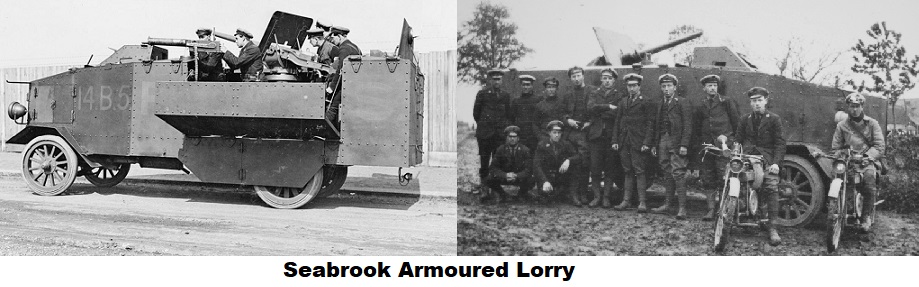
Type: Heavy Armoured Car
Place of origin: United Kingdom
Service history
In service: Mdl 1914 – 5 ton truck chassis, armoured bodywork, open superstructure, drop sides. 30 built (1915)
Production history
Designer: Wolseley Motors Ltd
Designed: 1914
Manufacturer: Wolseley Motors Ltd
Specifications
Weight: 9.1 metric tons
Length: m
Width: m
Height: m
Crew: 7 (commander, gunner, loader, mg gunner, mg loader, driver)
Armour: 8 mm
Main armament: 3-pdr (47mm) gun
Secondary armament: .303 Vickers machine gun
Engine: Continental liquid cooled petrol I4, 32.2 hp
Suspension: 4×2 wheel, leaf spring
Range: km
Speed: km/h,
off road: ?
The first Seabrook heavy armoured car was delivered by the Portholme Aerodrome Ltd., Huntingdon on 5 February 1915. The fitting of the vehicle was done under the supervision of Lieutenant Walter Wilson, who then joined the RNAS and was subsequently selected by the Landships Committe to develop what would become the Tank. The armoured Seabrook was much heavier than Commander CR Samson’s 1914 prototype and the springs, the wheels with their solid rubber tyres and the back axle often gave way. The weight of the cars made it difficult to cross even the smallest of gullies, severely restricting their mobility. The 3-pdr gun was very useful, however, prompting the C-in-C, Sir John French to ask the Admiralty to send more of them to France. Five squadrons were formed, of 6 heavy armoured cars each. The first squadron, though the vehicle was totally unsuited to desert conditions and easily bogged in the loose sand, was sent to Egypt in November 1915 while the other squadrons went to France.
Pierce Arrow AC
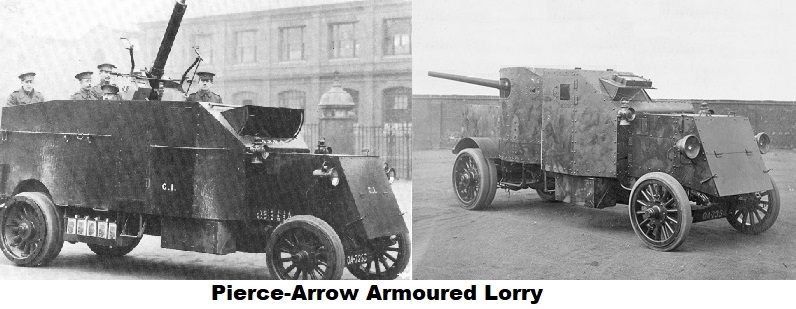
Type: Heavy Armoured Car
Place of origin: United Kingdom
Service history
In service: Mdl 1914 – 5 ton truck chassis, armoured bodywork, open superstructure, drop sides. 16 built (1915)
Production history
Designer: Wolseley Motors Ltd
Designed: 1914
Manufacturer: Wolseley Motors Ltd
Specifications
Weight: 9.1 metric tons
Length: m
Width: m
Height: m
Crew: 7 (commander, gunner, loader, mg gunner, mg loader, driver)
Armour: 7.5 mm
Main armament: 2-pdr (40mm) autocannon
or QF 3-pounder (47mm) Vickers gun
or QF 13-pounder 9 cwt (76mm) AA gun
Secondary armament: .303 Vickers machine gun
Engine: Continental liquid cooled petrol I4, 30 hp
Suspension: 4×2 wheel (double rear wheels), leaf spring
Range: km
Speed: km/h,
off road: ?
An Anti-Aircraft (AA) Brigade was formed by the Royal Marine Artillery (RMA) in the Autumn of 1914 for service in the field. The equipment chosen for this unit consisted of the Vickers Naval 2-pdr automatic cannon mounted on an armoured Pierce–Arrow 5-ton lorry chassis. Although there were only to be sixteen guns, forty-eight chassis were ordered for them, the balance with 5mm of armoure to be maintained as spares and service vehicles. The order for the armoured cars was placed with Wolseley Motors Ltd, a subsidiary of Vickers, on 30 December 1914 and were delivered by Wolseley between March and June 1915. Two batteries were equipped with guns and deployed to France by the end of April but the guns for a third battery were not received until August and the Brigade was not fully equipped until September. During the Summer of 1917, all four batteries of the unit was re-equipped with 3-inch AA guns (on different mountings) and the “pom pom” was withdrawn. Allen built four fire support vehicles mounting a 3 pdr (47mm) gun in a fully enclosed turret with 300 degrees of rotation on the back that would serve in Russia while Leyland built four similar vehicles with an enclosed superstructure and a MG turret that would serve in Africa and Egypt. In Russia the turret weight proved to be too heavy for the chassis so they were removed, the guns mounted on a pedestal with a shield and the hull sides filled in with flat plates similar to the AA version.
1915 Peerless AC
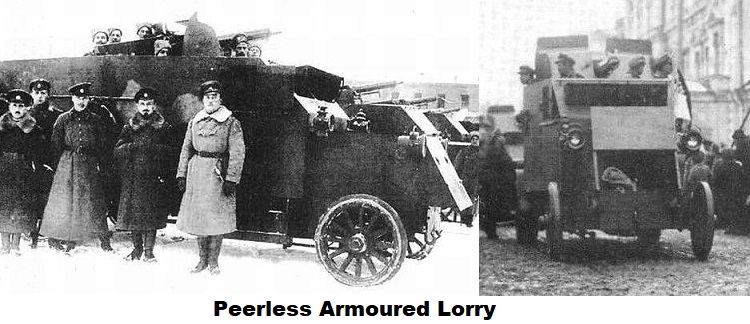
Type: AC
Place of origin: United Kingdom
Service history
In service: Mdl 1914 – 3-ton truck chassis, armoured bodywork, open superstructure. 64 built (1915)
Production history
Designer: Wolseley Motor Company
Designed: 1914
Manufacturer: Wolseley Motor Company
Specifications
Weight: 4.8 metric tons
Length: 6.12 m
Width: 2.23 m
Height: 2.77 m
Crew: 5 (commander, gunner, loader, mg gunner, driver)
Armour: 7.5 mm
Main armament: 2-pdr (40mm) autocannon
Secondary armament: .303 Vickers machine gun
Engine: Peerless liquid cooled petrol I4, 32 hp
Suspension: 4×2 wheel, leaf spring
Range: 145 km
Speed: 45 km/h,
off road: ?
In 1915, American Peerless trucks were modified by the British to serve as armoured cars and, like the practically identical Pierce Arrow, were relatively primitive designs with open backs and armed with a Pom-pom gun and a machine gun. Sixteen were sent to Russia and the remainder were delivered to the British army in 1915. The vehicle was robust, slow, and had terrible cross country performance. In 1919 a much improve Peerless would make an appearance sporting an armoured body built by the Austin Motor Company, hence its strikingly similar apparence to the Austin Armoured Car.
Ford AC
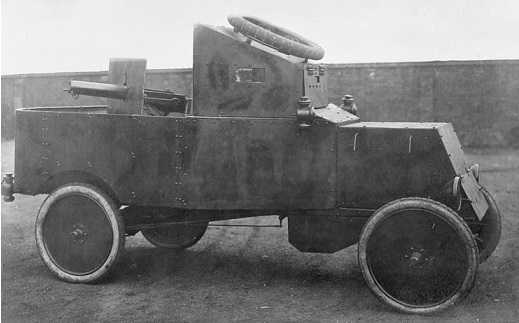
Type: Light Armoured Car
Place of origin: United Kingdom
Service history
In service: Car chassis, armoured bodywork, open superstructure, 11 built (1916)
Production history
Designer: Petty Officer L. Gutteridge
Designed: 1916
Manufacturer: W. G. Allen & Sons
Specifications
Weight: 1.1 metric tons
Length: 3.4 m
Width: m
Height: m
Crew: 3 (commander/mg gunner, mg loader, driver)
Armour: 5 mm (9mm gun shield)
Main armament: .303 Vickers machine gun
Secondary armament: None
Engine: Ford 2.9L liquid cooled petrol I4, 20 hp
Suspension: 4×2 wheel, leaf spring
Range: km
Speed: 35 km/h,
off road: ?
Early in 1916 the 1 Sqn, Royal Naval Armoured Car Division, asked its base in the United Kingdom to provide a light armoured car to complement the Lanchester and Seabrook establishment. The new vehicle was based Ford Model T as it had already demonstrated its sturdy cross country abilities in other theatres of war and was, moreover, simple and robust. It could be considered to be a direct descendent of the earlier Admiralty Talbot LAC, 6 of which had been built on the Talbot car chassis, and the Rolls-Royce LAC of 1914. As it was calculated that the conversion would double the Model T’s weight the chassis was reinforced with stronger suspension springs and tie rods on the back axle. The Model T’s quaint appearance had generated much mirth on their arrival in the Dobruja area of Russia but, as the autumn rains had set in and several of the heavier cars bogged down and were lost, they continued wallowing along through the mud without undue difficulty.
CANADA
Autocar AC
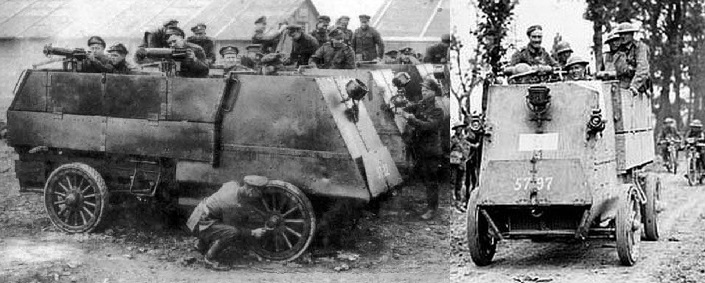
Type: Light MG Carriers
Place of origin: Canada
Service history
In service: 1.5 ton truck chassis, armoured bodywork, open superstructure, 20 built (1914)
Production history
Designer: Captain Raymond Brutinel
Designed: 1914
Manufacturer: Autocar Company
Specifications
Weight: 2.7 metric tons
Length: 4.5 m
Width: 1.1 m
Height: 1.8 m
Crew: 6 (commander, driver, 2x machine gun crews)
Armour: 9.5 mm
Main armament: 2x .303 Colt Mdl 1895 machine gun
or 2x .303 Vickers machine gun
Secondary armament: .303 Colt Mdl 1895 machine gun
or .303 Lewis Machine Gun
Engine: 2.5L 2-cyl petrol, 20 hp
Suspension: 4×2 wheel, leaf spring
Range: km
Speed: 25 km/h,
off road: ?
When mobilization came in 1914, Captain Brutinel formed the Automobile Machine Gun Brigade and raised the funds for its equipment. This force consisted largely of Autocar armoured vehicles, which had been built in Pennsylvania, USA in Oct 1914 and purchased by public subscription in Canada in 1915. Autocar armoured carriers were built on Type XXI truck chassis with solid tyres and armoured with 9.5 mm plate supplied by the Bethlehem Steel Corporation. The armour gave all-round protection but was unusual in that it not only offered no head cover for the driver, but had no vision port in the front plate. Eight cars were made into Machine Gun Carriers while the remainder were service vehicles but all were made mechanicaly identical so parts could be swapped around. The MG carriers were not initially intended to go into action as fighting vehicles but by August 1916, when the unit depoyed from England to France, the Vickers MG’s were mounted on a swivel mount allowing them 360 degree rotation. However, because the armour only extended to waist height their crews suffered an exceptionally high casualty rate. The 1st Canadian Motor Machine Gun Brigade (and later the 2nd CMMGB) were unique armoured units in the Canadian Corps. The decision to support the two MG batteries with the trench mortars mounted in lorries meant they had their own fire support and the cyclists gave them infantry. The force therefore contained the capacity to manoeuvre with its own fire support and was instrumental in holding the German offensive of March 1918.
Jeffery AC
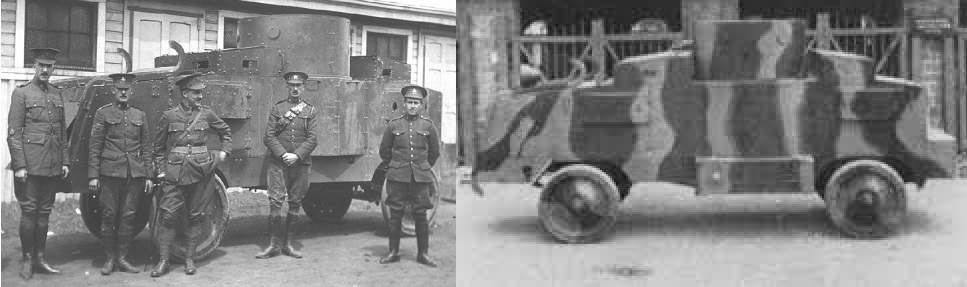
Type: Heavy Armoured Car
Place of origin: Canada/United States
Service history
In service: Car chassis, armoured bodywork, single fully rotating turret. 40 built (1915)
Production history
Designer: Jeffery Motor Co
Designed: 1914
Manufacturer: Canadian Cycle and Motor Co
Specifications
Weight: 8 metric tons
Length: 5.48 m
Width: 1.95 m
Height: 2.44 m
Crew: 4 (commander, driver, mg gun crew)
Armour: 7 mm
Main armament: .303 Vickers machine gun
Secondary armament: None
Engine: Buda 4.7L liquid cooled petrol I4, 40 hp
Suspension: 4×4 wheel, leaf spring
Range: km
Speed: 32 km/h
off road: 16 km/h
Used by the privately financed Eaton, Yukon and Borden Motor Machine Gun Batteries, which would later become part of the 1st Canadian Motor Machine Gun Brigade. The four-wheel drive Quad had steering and brakes on all four wheels but its cross-country performance was restricted by its excessive weight and solid tires. In 1917 they were presented to the British government and sent to assist in security operations in India and Ireland.
FRANCE
Renault AM

Type: Armoured Car
Place of origin: France
Service history
In service: Mle 1914 – truck chassis, 4mm armoured bodywork, open superstructure, 4 tonnes, 100 built (1914)
Mle 1915 – increased armour, 50 built (1915 – 17)
Production history
Designer: Renault
Designed: 1914
Manufacturer: Renault
Specifications
Weight: 4.9 metric tons
Length: 4.8 m
Width: 1.8 m
Height: 2.8 m
Crew: 4 – 5 (commander, driver, gunner, loader)
Armour: 5 mm
Main armament: Puteaux SA 18 37mm gun (400)
or 6.5 mm Hotchkiss Mle.14 machine gun (5500 rds)
Secondary armament: 6.5 mm Hotchkiss Mle.14 machine gun (5500 rds)
Engine: Renault liquid cooled petrol I4, 18 hp
Suspension: 4×2 wheel (double rear wheels), leaf spring
Range: 140 km
Speed: 40 km/h
off road: ? km/h
Renault became involved in armoured car construction at an early stage and the company completed its first order for one hundred vehicles in November 1914. These were in action a month later, manned by marines. Subsequent models, mounting 37mm guns, were built with improved armour protection and 30 of these were sent to Russia.
Peugeot AM
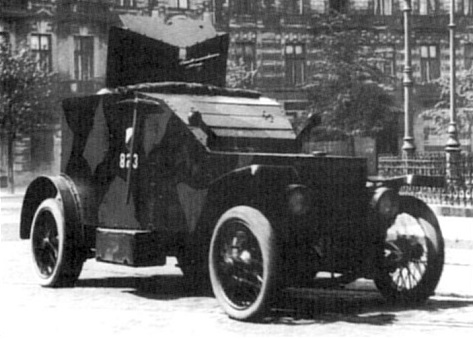
Type: Armoured Car
Place of origin: France
Service history
In service: Mle 1914 – truck chassis, 3mm armoured bodywork, open superstructure, 24 hp engine, Schneider 37mm mle 1897 gun,
3.6 tonnes, 30 built (1914)
Mle 1915 – rear dual wheels, increased armour, enclosed superstructure, single fully rotating turret, 120 built (1915 – 17)
Production history
Designer: Capt. Reynaud
Designed: 1914
Manufacturer: Pugeot
Specifications
Weight: 4.9 metric tons
Length: 4.8 m
Width: 1.8 m
Height: 2.8 m
Crew: 4 – 5 (commander, driver, gunner, loader)
Armour: 5.5 mm
Main armament: Puteaux SA 18 37mm gun (400)
or 6.5 mm Hotchkiss Mle.14 machine gun (5500 rds)
Secondary armament: 6.5 mm Hotchkiss Mle.14 machine gun (5500 rds)
Engine: Pugeot liquid cooled petrol I4, 40 hp
Suspension: 4×2 wheel (double rear wheels), leaf spring
Range: 140 km
Speed: 40 km/h
off road: ? km/h
The Peugeot armored car, improvised from an existing commercial Peugeot truck, was rapidly developed by the French Army in 1914 to halt the advance of German forces and underwent a rapid series of developmental changes once entering production. Early experiences on the battlefield quickly brought about improvements in armament and firepower. The vehicle was designed for speed and movement, making it suited to counter the initial German invasion of France in 1914 and the Peugeot’s speed was brought to advantage to stem the German breakthrough of March 1918. Following World War I, 18 were handed over to the Poland and 4 to Serbia, where they remained in service for several years.
White-Laffly AM
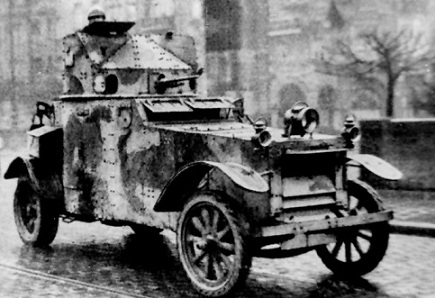
Type: Armoured Car
Place of origin: France/United States
Service history
In service: Mle 1915 – 1.5-ton truck chassis, 6.35 mm armoured bodywork, single fully rotating turret, 5.5 tonnes. 20 built (1915)
Mle 1918 – 280 built (1918)
Production history
Designer: Laffly
Designed: 1915
Manufacturer: White Motor Company/Laffly
Specifications
Weight: 5.9 metric tons
Length: 5.6 m
Width: 2.1 m
Height: 2.75 m
Crew: 4 (commander, driver, gunner, loader)
Armour: 8 mm
Main armament: Mdl 1916 37 mm Hotchkiss gun (198 rds)
or 7.7mm Hotchkiss Mle.14 machine gun (5500 rds)
Secondary armament: 7.7mm Hotchkiss Mle.14 machine gun (5500 rds)
Engine: White liquid cooled petrol I4, 37 hp
Suspension: 4×2 wheel (double rear wheels), leaf spring
Range: 250 km
Speed: 46 km/h
off road: ? km/h
The French Government began receiving, in 1915, supplies of trucks built by the White Motor Co. of Cleveland, Ohio and by the end of the same year the first twenty armoured cars were constructed in France on White chassis. Overall, the French were happy with the performance of their White truck based armored car and, near the end of WWI, built 205 examples of the more refined the Mle18. These should not be confused with the series of experimental armoured cars developed by White in the United States for the US Army, however White did build 75 armoured cars to the Mle 18 pattern for the the American Expeditionary Force known as the White AEF.
ITALY
Lancia IZ AM
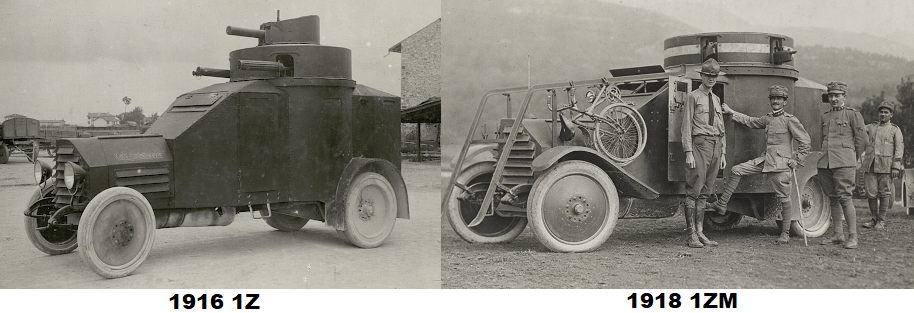
Type: Armoured Car
Place of origin: Italy
Service history
In service: Mle 1916 – truck chassis, armoured bodywork, single fully rotating turret w/ top turret, 4.2 tonnes, 35 hp engine. 10 built (1915)
Mle 1918 – top turret deleted, wire cutting rails installed, 110 built (1918)
Production history
Designer: Lancia
Designed: 1916
Manufacturer: Ansaldo
Specifications
Weight: 3.7 metric tons
Length: 5.4 m
Width: 1.82 m
Height: 2.4 m
Crew: 6 (commander, driver, 3x mg gunner, mechanic)
Armour: 8 mm
Main armament: 2x 8mm St. Étienne Mle 1907 (8000 rds ea)
Secondary armament: 8mm St. Étienne Mle 1907 (8000 rds)
Engine: liquid cooled petrol I4, 40 hp
Suspension: 4×2 wheel (double rear wheels), leaf spring
Range: 300 km
Speed: 60 km/h
off road: ? km/h
The Lancia IZ armoured car was an advanced design for its day and was the most common of the early Italian armoured cars. Though a few were deployed in the northern parts of the country, where they saw combat against the Austro-Hungarian Army, the Lancia IZ saw little combat in World War I due to the mountainous terrain in which the Italian Royal Army fought. After World War I, Lancia IZ armoured cars were sent to the Kingdom of Albanian, North Africa and East Africa for policing duties.
UNITED STATES
King AC
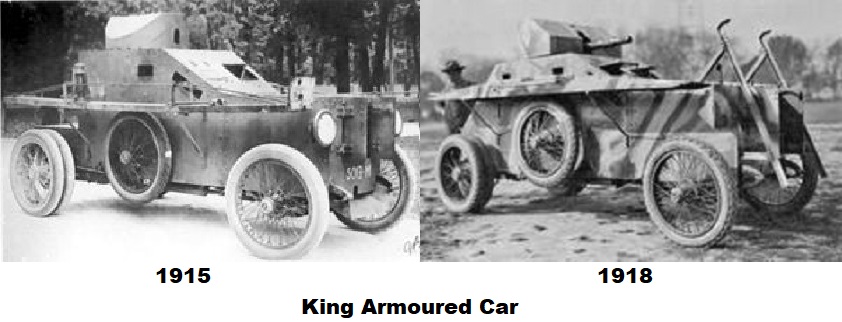
Type: Light Armoured Car
Place of origin: United States
Service history
In service: Mdl 1915 – Car chassis, armoured bodywork, single fully rotating turret. 8 built (1915)
Mdl 1917 – sloped rear hull, 80 hp engine, 105 km/h, 5 upgraded (1917)
Production history
Designer: Armored Motor Car Company
Designed: 1915
Manufacturer: Armored Motor Car Company
Specifications
Weight: 2.4 metric tons
Length: 3.9 m
Width: 2 m
Height: 2.3 m
Crew: 3 (commander, driver, machine gunner)
Armour: 6.35 mm
Main armament: .30 M1895 Colt-Browning Machine Gun
or .30 Lewis Machine Gun (550 rds)
Secondary armament: None
Engine: King liquid cooled petrol V8, 70 hp
Suspension: 4×2 wheel (double rear wheels), leaf spring
Range: 322 km
Speed: 72 km/h
off road: ? km/h
Tensions on the souther boarder inspired many American armoured car designs, such as the REO, Maxwell, White, Mack and Davidson-Cadillac armoured cars, however the United States’ isolation from the European conflict until 1917 meant that few American armoured cars saw combat during the First World War. The King Armored Car was the first American armored vehicle, built in 1916 for the United States Marine Corps 1st Armored Car Squadron – the USA’s first formal armored unit – and the US Army. It was designed to be quite easy to transport and could be taken ashore whole or broken down into smaller pieces to be put into motor launches, taken ashore, and reassembled on the beach. However, it could not be considered an unqualified success as it was not initially very reliable, though it was later improved upon. The vehicle saw no use in Europe but was used in later conflicts on Hispaniola and in Central America.
GERMANY

Ehrhardt E-V/4
Type: Heavy Armoured Car
Place of origin: German Empire
Service history
In service: Mdl 1915 – truck chassis, armoured bodywork, fixed turret, 8.86 tonnes. 1 built (1915)
Mdl 1917 – single fully rotating turret, revised frontal armour, 20 built (1917)
Production history
Designer: Ehrhardt
Designed: 1915
Manufacturer: Ehrhardt
Specifications
Weight: 7.12 metric tons
Length: 5.3 m
Width: 2 m
Height: 2.85 m
Crew: 8 – 9 (commander, driver, 3x machine gun crews)
Armour: 7 – 9 mm
Main armament: 3x 7.62 Maxim Machine Guns
Secondary armament: None
Engine: liquid cooled petrol V8, 80 hp
Suspension: 4×4 wheel (double rear wheels), leaf spring
Range: 250 km
Speed: 61.3 km/h
off road: ? km/h
Having been distinctly inconvenienced by Belgian and British armoured cars during the opening phase of WWI, the German Army approached the car manufacturing companies Ehrhardt, Daimler and Büssing and ordered a prototype armoured car from each. During 1915, the three companies produced the ordered prototypes, the largest of which was the Büssing of which only 3 would eventually be produced as it was considered inferior to the Ehrhardt. The Ehrhardt and Daimler designs were very similar. Along with some improvised conversions, the three prototypes were formed into one unit and sent to first the Baltic and then to the Western Front where they were supplimented by 20 examples of an improved versions of the Ehrhardt in 1917. These new cars were very similar to the 1915 prototype, but incorporated some of the lessons learned from operational use of all three makes of experimental vehicle. However, the requirement for armoured cars were so high that by 1918 that the Germans were forced to employ numbers of captured Ischorsky (11), Garford-Putilov (6), Minerva (4), Armstrong-Whitworth (3), Lancia (4) and Austin (4) armoured cars, as well as a few examples of other types, for a total of some 40 vehicles. An additional 20 Ehrhardt armoured cars were ordered and produced in 1919 for policing duties within Germany.
BIBLIOGRAPHY
Early Armoured Cars, E Bartholomew, Shire Publications Ltd, 1988
http://www.soldatinidicarta.altervista.org/WW1%20-%20Early%20Armored%20Cars.pdf
WW1 Armoured Cars, War is Over
http://www.wio.ru/tank/ww1ba.htm
Armoured Car Articles, various authors, Landships II
http://www.landships.info/landships/car_articles.html#
Tanks: Over 250 of the World’s Tanks and Armoured Fighting Vehicles By Chris Chant, Richard Jones, Summertime Publishing Ltd, 2004
http://books.google.ca/books?id=8CwgxzMqrv0C&pg=PA48&lpg=PA48&dq=Minerva+armoured+car+in+russia&source=bl&ots=56iUkXaXns&sig=RLGuTvCVEzzGXMN0tn19fsS5NR0&hl=en&sa=X&ei=ZbZ-UvOKI4f8iwK814G4Cw&ved=0CHIQ6AEwCw#v=onepage&q=Minerva%20armoured%20car%20in%20russia&f=false
WWI – Belgium Armoured Car Division in Russia by Michael Barden, 16 April 2011
http://www.philatelicdatabase.com/postal-history/wwi-belgium-armoured-car-division-in-russia/
THEY SAID IT WAS PEERLESS by David Fletcher, Classic Military Vehicle 119, April 2011
http://www.cmvmag.co.uk/features/67-they-said-it-was-peerless
American Military Vehicles of World War I by Albert Mroz, McFarland and Co, 2009
http://www.offroadvehicle.ru/AZBUCAR/FWD/%5BAlbert_Mroz%5D_American_Military_Vehicles_of_World_%28Bookos.
 In Janissarius Scripturam